The history behind Pine Fort Days
When we began attending Pine Fort Days at the Spruce Woods Visitor Centre in 2019, we were fortunate to be assigned a dedicated camp guide that helped us each year after, Thomas Corry, the Master of the Pine Fort Trading Post.
This year, however, we sadly had to navigate the event without him, as he was temporarily reassigned to another Fort.
Let us first delve into the history of Pine Fort, drawn from the Manitoba Historical Society Archives.
“Located along the trade route of the Assiniboine River, where it branches southward to the Missouri, Pine Fort was strategically positioned to secure furs from the Cree, Ojibway, and Assiniboine, as well as buffalo robes, horses, and corn from the Mandans. As a North West Company post, it evolved into a pemmican and trade goods depot, supplying posts throughout the Assiniboine and Souris valleys. However, competition with the Hudson’s Bay Company and disruptions in Native trade alliances led to a decline in trade and the eventual abandonment of Pine Fort on three separate occasions.
In the early 1700s, the Assiniboine people occupied the northern plains from the Red River to the Rocky Mountains. The Assiniboine River bears their name, stemming from this branch of the Dakota Nation. Comprising several independent groups totalling about 28,000 people, they spoke Nakota, a variant of the Siouan Dakota language. They travelled extensively throughout the year, residing in encampments of 400 to 1,500 people and sometimes gathering in groups of up to 3,000.
The Assiniboine played a pivotal role in shaping the inland fur trade. They encouraged and guided early explorers like Pierre Gaultier de Varennes de La Verendrye, provided pemmican to forts and fur brigades, and traded as far north as York Factory on Hudson Bay. Their alliances with the Cree and Ojibway to the north and east, along with the Mandan and Hidatsa to the south, formed a robust trading network that laid the foundation of the early fur trade.
By the mid-1800s, European diseases had significantly reduced the Assiniboine population. In response to the westward expansion of the fur trade and the decline of local bison herds, the Assiniboine migrated from southwestern Manitoba to Saskatchewan, Alberta, and Montana, where their descendants still reside today.”
As part of the Spruce Woods Park Interpretation Programs, Pine Fort Days offers visitors a chance to step back in time and learn about the ways of our ancestors.
Although we missed the Friday evening opening ceremonies, featuring a cannon display, bannock bake, and camp exploration, we heard it was a fantastic opportunity to engage with our history firsthand.
On Saturday, the Pine Fort Walking Tour provided an exceptional experience, blending rich historical content with insightful information. The tour was meticulously organized and engaging, making it a truly informative outing, which was also available on Sunday.
The Rendezvous Camp, while slightly smaller this year, was executed beautifully, as always.
Blister sat in front of his tent, captivating a large group with tales of his travels and adventures. Though his stories may not have been entirely factual, they were entirely credible, and his knowledge of period firearms was proven to be astonishing!
Our annual visit to Scruffy’s tent has always been a delight. His anecdotes about travels, adventures at different Forts, and daily life always feel refreshingly genuine. He is a remarkable storyteller.
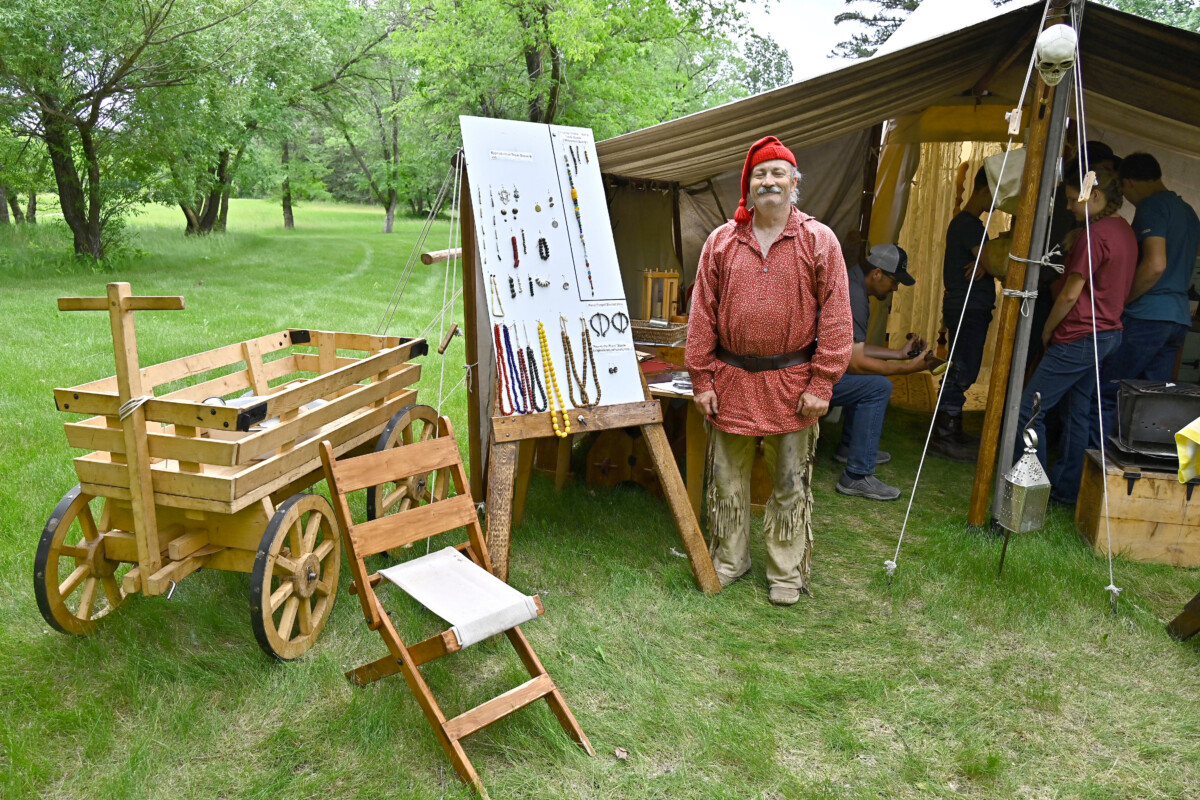
Captain Cornbread and his charming wife, Stands with a Fist, both shared a wealth of historical knowledge and a wide range of items, including a display of authentic trade beads over 200 years old. They also hosted a highly successful giveaway for anyone who discovered one of several golf balls cleverly hidden around the camp. There were three prize categories: the grand prize was one of many cozy fur hats with flaps, the medium prize was a water gun, and the small prize consisted of a necklace and bracelet made of beads and shells. All the winners were ecstatic with their gifts, and the water guns were well used.
All of the individuals making up the rendezvous camp shared the same sentiment: “We can bring history to life and make it interesting. We all have so much fun hosting events like this and sharing our accumulated knowledge.”
While many romanticize the simplicity of life in the “olden days,” re-enactments such as this highlight that it wasn’t so simple after all, the modern conveniences we enjoy today truly make life much easier.
In today’s world, a trip to a store of our choice allows us to stock up on all the necessities for our households, be it food, soap, or clothing, which stands in stark contrast to the days of the voyageur, when most items were handmade rather than purchased.
Though the Pine Fort Days voyageurs appeared peaceful and relaxed in their camp, basking in the warmth of a summer day, refreshed by the previous rain, life back then was filled with the constant hustle and bustle from dawn to dusk, with an endless list of tasks to accomplish.
The relentless pursuit of food, hauling water, tending to animals, caring for children, and growing gardens meant that the workday never truly ended. They had to contend with challenging weather as well—heat, rain, wind, and cold. The original camp communities fostered collaboration and strengthened relationships by sharing many responsibilities.
A heartfelt thank you to the Voyageurs who made this weekend so memorable once again; we eagerly anticipate their return next year!
Side note: Saturday morning, the camp had several visitors, including some very chatty squirrels and a young black bear who seemed more concerned with the humans than the humans were with the bear.
PHOTO CAPTION: Captain Cornbread showing his display of trade beads. Many of the beads are over 200 years old and are just as pristine as they were when first made.