Behind the siren ... commitment and training in rural fire departments
Local firefighters are often seen throughout our communities volunteering at fundraising events, supporting community celebrations, leading the way in the annual Christmas Parade, and of course donning their gear and climbing aboard the fire truck when an emergency call comes in. But for members of the Glenboro–South Cypress Fire Department, the call to serve doesn’t begin when the pager goes off. It begins long before…during regular training nights, equipment checks, and hands-on exercises designed to keep their skills sharp and ensure they are ready when their community needs them most.
Behind every emergency response are hours of preparation. Members of the department dedicate time each month to training that helps them stay current with firefighting techniques, safety procedures, and equipment operation. These sessions not only strengthen their technical abilities but also build the teamwork and communication that are critical when responding to real-life emergencies.
Training officer Braydon Cullen, who is employed as a full-time firefighter at CFB Shilo, says the department follows a steady rhythm throughout the year, balancing foundational skills with more specialized scenarios.
“We try to cover the basics every year,” Cullen explains. “Things like SCBA (self-contained breathing apparatus) maintenance, learning how to properly put it on and take it off, deploying different sizes of hose lines, and working with ladders. That’s the core of what we do.”
But beyond the fundamentals, local firefighters are also getting valuable, real-world experience through controlled training environments. The Glenboro Refuse Station enables the department access to a setup of modified sea cans used for live burn exercises.
“It gives us a controlled setting to go through the motions,” Cullen says. “If we ever have to respond to a real structure fire, it’s not the first time we’ve experienced that kind of environment.”
The site has also become a regional training hub, hosting departments from across the mutual aid district, including communities like Baldur, Belmont, Cypress River and Holland. Together, they take part in joint exercises ranging from live burns to vehicle extrication.
Those extrication practices often involve dismantling scrap vehicles have evolved in recent years thanks to upgraded equipment.
“We’re very fortunate now to have battery-operated tools,” Cullen notes. “Before, with hydraulic systems, there were pumps and hoses to hook up. Now it’s cordless, quicker, and more efficient.”
The specialized tools were purchased through community fundraising efforts, including the department’s popular annual Fireman’s Breakfast during Glenboro’s Annual Curling Bonspiel.
Again this year the breakfast served over 300 plates which received favourable reviews. “That support is huge for us,” he says. “It allows us to keep our equipment up to date and continue training at a high level.”
In a rural municipality, training also extends beyond fire response. Firefighters regularly tour local farms, businesses, and public buildings to better understand potential hazards and layouts before emergencies happen.
“We’ve gone through local farms with grain dryers, seed cleaning operations, and chemical storage,” Cullen says. “It’s important to know what’s inside those buildings, where hazards might be, before you’re responding under pressure.”
That preparation includes specialized training for incidents involving agricultural chemicals, such as anhydrous ammonia, as well as walkthroughs of schools, hospitals, and local businesses.
The department trains every two weeks from September through June, alternating between hands-on exercises and equipment maintenance nights. Even after calls, the work continues.
“People see the trucks go back to the hall and think we’re done,” Cullen says with a laugh. “But there’s still an hour or more of cleanup, washing equipment, rolling hoses, and paperwork.”
And while firefighting can involve intense, high-risk situations, Cullen emphasizes there’s a role for everyone.
“Not everyone has to go into a burning building,” he says. “There’s traffic control, equipment support, cleanup; every scene has a lot of jobs so everyone can contribute in some way.”
Looking ahead, Cullen hopes to expand training opportunities even further, including acquiring an abandoned structure that could be used for realistic search-and-rescue simulations.
“To go through a real house layout, even with simulated smoke, would be extremely valuable,” he says. “It helps prepare people for the stress and conditions they might face.”
That preparation is especially important for a department made up largely of younger members eager to learn.
“We’ve got a great group right now,” Cullen says. “A lot of them are in their 20s, they’re motivated, and they want to train. That makes a big difference.”
As well as the ongoing training, every member has to have their First Aid and recertification is every three years. Manitoba Emergency Services College out of Brandon provides a number of courses that many local members have taken advantage of. “Presently there are a few members signed up for Wildland fire and vehicle extrication. These courses are hosted in Holland by the college. These courses require a major time commitment from our volunteers. Once completed and signed off each participant is presented with a certificate from the college,” explained Cullen.
For Cullen and the Glenboro–South Cypress Fire Department, training isn’t just about meeting requirements, it’s about being ready when the community needs them most.
“Thankfully we don’t get calls every day, so keeping on top of our skills and training is vital to the safety of our volunteers and our community,” Cullen said.
Because in a small town, when the pager sounds, there is no time to learn, only time to act and rely on training.
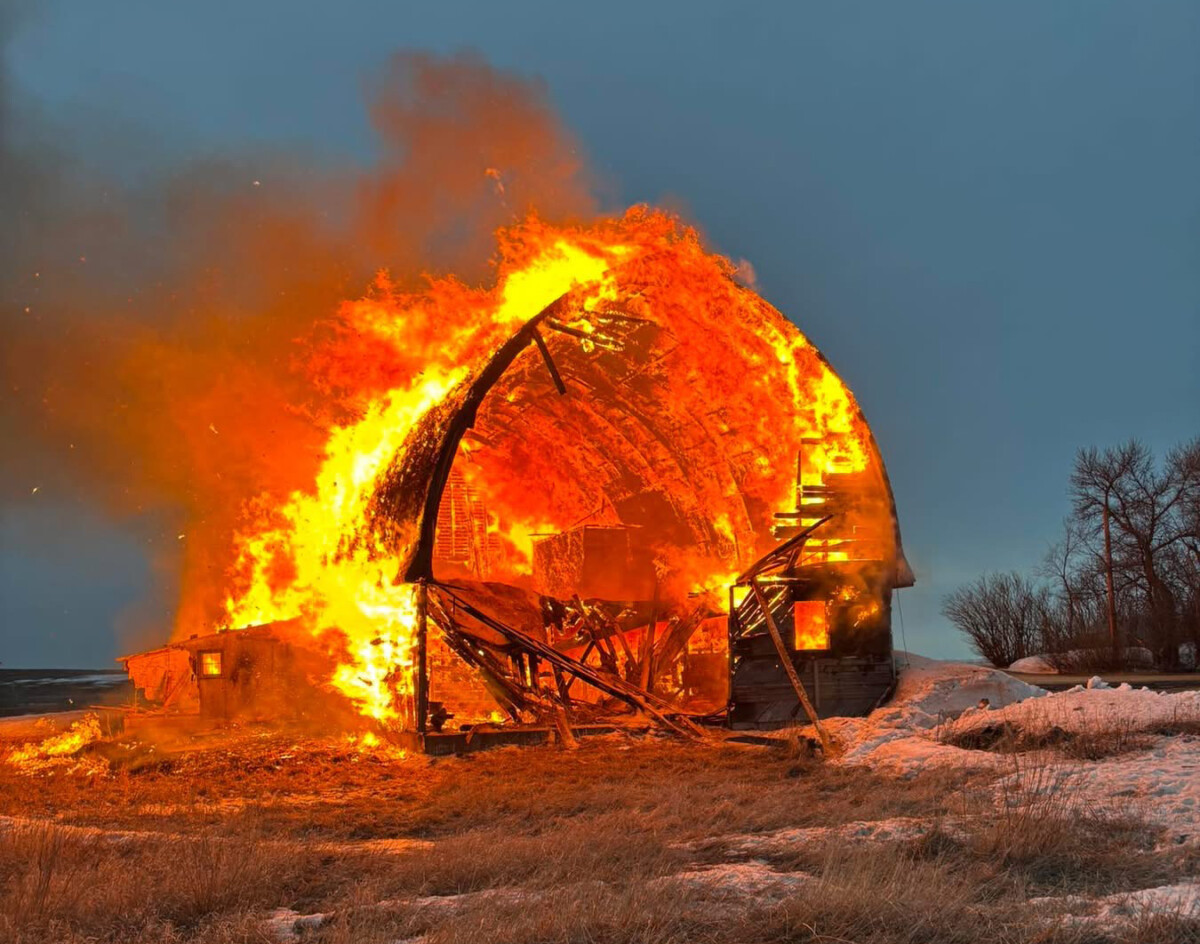
PHOTO CAPTION: A controlled burn was recently performed at Kent and Sandra Hamilton’s south of Glenboro. Training officer Braydon Cullen commented that a burn such as this is a great opportunity for new volunteers to see how fast a building can burn down. PHOTO SUBMITTED